Facing uncertainty with creativity
An antidote to hopelessness

I‘m still thinking about an evening I spent a few weeks ago with a local group of activists.
That night, the topic of navigating uncertainty was at the heart of our discussion. It wasn’t overtly political, although the uncertainty we were referring to is, in this moment, largely coming from Washington DC. Instead, it was full of techniques to use for all kinds of uncertainty.
During the gathering, we talked about aging parents, about scary health-related news, about guiding our children into adulthood and beyond–about all that adult stuff that I swear needs to go into a handbook for adulting that each of could get when the time came that would tell us HOW to navigate all the things being an adult in this world throws our way. And yes, we talked about what it means to be an American in this moment, and, most importantly, how to remain true to our values, morals, and ethics when so many pieces of those values, morals, and ethics are under attack at the federal and even global level.
The path of fear, exhaustion, & burnout
I learned a new term in that circle of activists, one that you may already be familiar with if you’re a healthcare worker: moral distress. This is the distress we feel when we know what is ethically right and yet are unable to act upon it due to circumstances beyond our control. Some of the words to describe the symptoms of moral distress include uncertainty, exhaustion, a feeling of futility, disengagement, and burnout.
A lot of writers I’ve been talking to recently have expressed similar feelings about the experience of trying to write, polish, and sell their work in the current market. So I think this is a useful term for us to explore in writing as in life.
Embarking on an uncertain writing journey when we’re living in global uncertainty and chaos can feel like a double-whammy–something not even worth doing if it’s only going to lead to more uncertainty and exhaustion (see where futility comes in here?). But I want to encourage you to interrupt this train of thought if that’s how you’re feeling right now. Sure, it’s one way (I’d say a very left-brained way) of looking at the writing life, one that searches analytically for a cold-hard return on investment of time, money, and effort.
What’s the alternative right-brained antidote to this thinking, then? Flow, presence, connection, and creativity. I’ve written a few posts already about the value of finding flow in your writing life, but the benefits extend past getting words onto the page.
And this is why flow is so important to me as a creative and an activist:
“To overcome the anxieties and depressions of contemporary life, individuals must become independent of the social environment to the degree that they no longer respond exclusively in terms of its rewards and punishments. To achieve such autonomy, a person has to learn to provide rewards to herself. She has to develop the ability to find enjoyment and purpose regardless of external circumstances.”
― Mihaly Csikszentmihalyi, Flow: The Psychology of Optimal Experience
I don’t think it’s too controversial to say that if you’re looking to the news and the world around you for hope, you’re probably going to end up disappointed, fearful, paralyzed. If you’re able to create an inner well of hope that you can tap into when everything seems to be going up in flames, you will probably be better equipped to take care of yourself and the people who need you.
Whole brain living
Part of the reason I’m thinking about left-brain/right-brain psychology is because I recently picked up Whole Brain Living by Jill Bolte Taylor.
“Peace really is just a thought away, and the key to your brain’s health will rest in your ability to find the story that speaks to you, followed by your commitment to that technique.”
- Jill Bolte Taylor
In her book, she uses a technique she calls the Brain Huddle, which I’ve been using to keep my brain calm during the storms around me:
Breathe: Pause and focus on your breath to center yourself
Recognize: Identify which character [left-brain thinking, left-brain emotion, right-brain thinking, or left-brain emotion] is currently dominant
Appreciate: Acknowledge the value of each character
Inquire: Ask for input from all four characters
Navigate: Make a decision based on the collective wisdom
This is absolutely the opposite of that fear and uncertainty, right? Breathe, recognize which part of you is dominating the current moment, appreciate (this felt so in line with all the reading I’ve been doing about Internal Family Systems, which is a topic for another day!), inquire/get curious, and make a decision that feels values aligned.
For me, those decisions have looked a lot less like panic/reaction and a lot more centered and calm since I’ve been focusing on getting out of my moral distress and left-brained critical talk and into a more creative, flow- and presence-based space. Join me–it’s a lot safer over here than in that other place.
I know I’ve been un-repentantly fan-girling over Martha Beck’s new book, Beyond Anxiety, so I hope you’ll indulge me for one more reference to her here:
“Criticism is an alluring substitute for creation, because tearing things down, unlike building them up, really is as easy as falling off a stump. It’s blissfully simple to strike a savvy, sophisticated pose by attacking someone else’s creations, but the old adage is right: Any fool can burn down a barn. Building one is something else again.”
― Martha Beck
Let’s build some (story) barns together this week, shall we? I guarantee it’s the antidote to all that ails us, in writing and in life.
Speaking of breaking status quos…
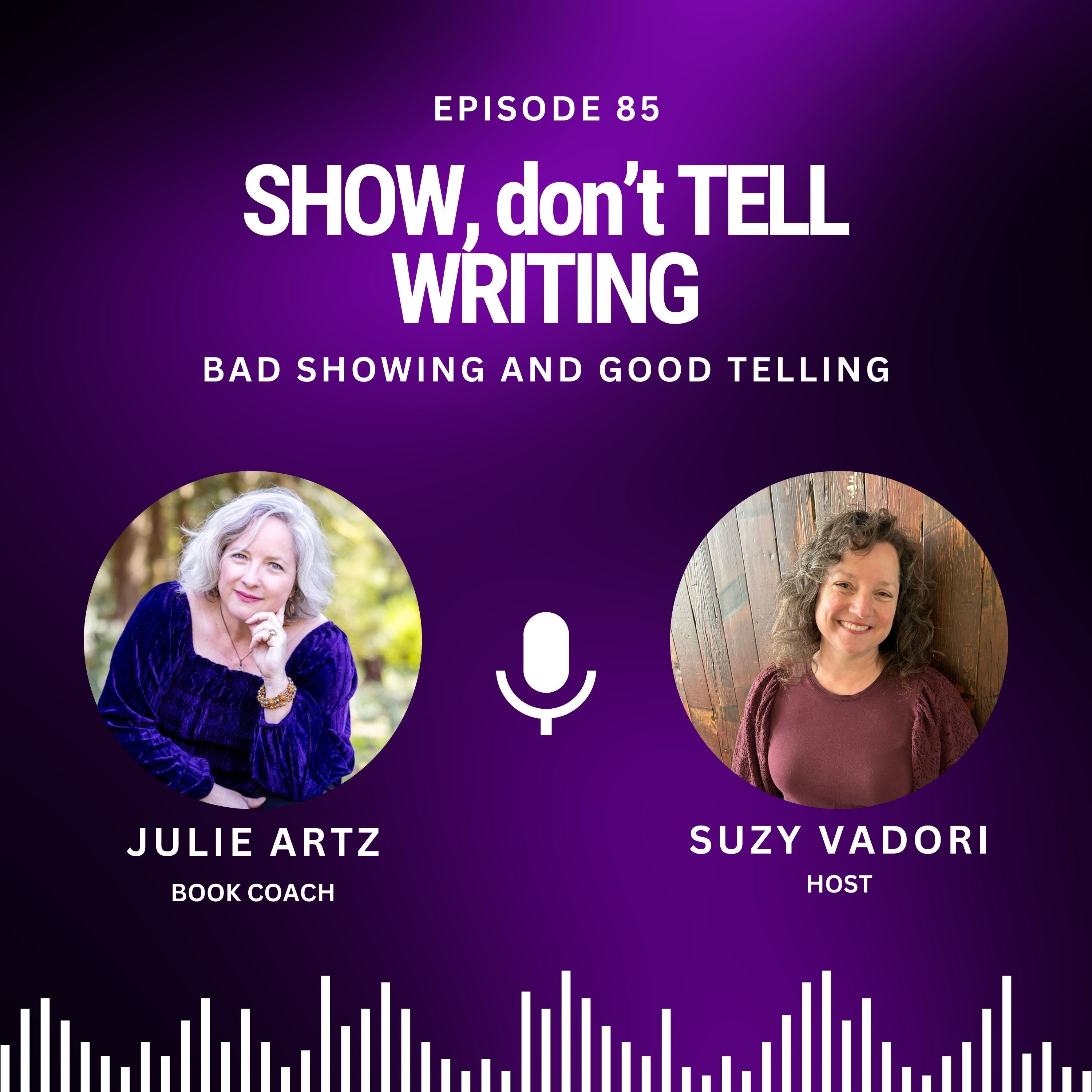
I recently sat down with fellow book coach Suzy Vadori on Show, don’t Tell Writing to talk about when to break the old writing rule “show, don’t tell.”
I think there are very few writing “rules” that can’t be broken. So I wanted to give the other side of this (admittedly very useful) rule.
Listen to us geek out about bad showing and good telling here. And thank you so much to Suzy for having me on the show!