

How to stop wasting energy on revision.
Are you trapped in the Writer's Bermuda Triangle? You're not alone.

I spoke with a writer recently who had just paid quite a bit of money to have her manuscript line-edited. And it broke my heart, because there were obvious big-picture structural issues with her story that meant the time she spent implementing line edits, not to mention the money she paid, was mostly wasted. It’s so easy to get overwhelmed by the scope of a revision such that you fall back on what you’re comfortable with: line-level polishing. Please – for the sake of efficiency, for the sake of your story, and for the sake of your sanity – always revise for structure first.
Another client felt that she’d gotten lost in the weeds and didn’t have a clear direction on revisions. She told me she felt like she was putting together a complex puzzle.
The puzzle analogy was hers, but it’s a great image to explain my approach to revision.
When you first dump out a 2,000 piece puzzle you’re going to look at it and think “There is no way this mess is going to look like a basket full of puppies.” It’s the same for starting a revision: you have a vision for the final book, but you don’t yet know how you’re going to get there.

A lot of folks will feel will hear the siren’s call to start their revision at page one. Please plug your ears! Resist! That would be like picking up one puzzle piece and then meticulously testing every single other piece to find the one that fits.
Take a second, instead, to think about your puzzle assembly strategy. Usually, the first step of putting a puzzle together is flipping over all the pieces so you can see what you’re working with.
The first step of a revision is the same: taking stock of what’s in your manuscript.
My favorite method for doing this is to compare my draft against my messy synopsis.
(If you didn’t write a synopsis before drafting, I guarantee you that doing it afterwards will still be worthwhile. I’ve written before about creating a messy synopsis to guide your story – here’s how it’s done.)
This strategy is one of my go-tos because it reduces mental clutter. Your brain is just not made to hold all the information in a 80-100,000 word document at once. When you condense it down into the 7-10 pieces of high level information needed for a synopsis, it is now a manageable size for your brain.
Don’t worry, the puzzle analogy doesn’t stop there.
Now that you’ve taken stock of what’s in front of you, you’re probably going to try to find and fit together the corner and edge pieces. This is your big picture framework – you now know the bounds you are working within.
You’ll then start matching colors and images together; putting like with like, finding themes. From there you can start assembling larger chunks before finding the pieces that connect them and filling in the details.
I think you know where I’m going here…
This is the same way I think about revision passes; you need to clarify the shape of the book before you start tinkering at the sentence or even paragraph level.
Author Accelerator’s Hierarchy of Editorial Concerns (h/t Jennie Nash) is my holy grail for structuring a revision.
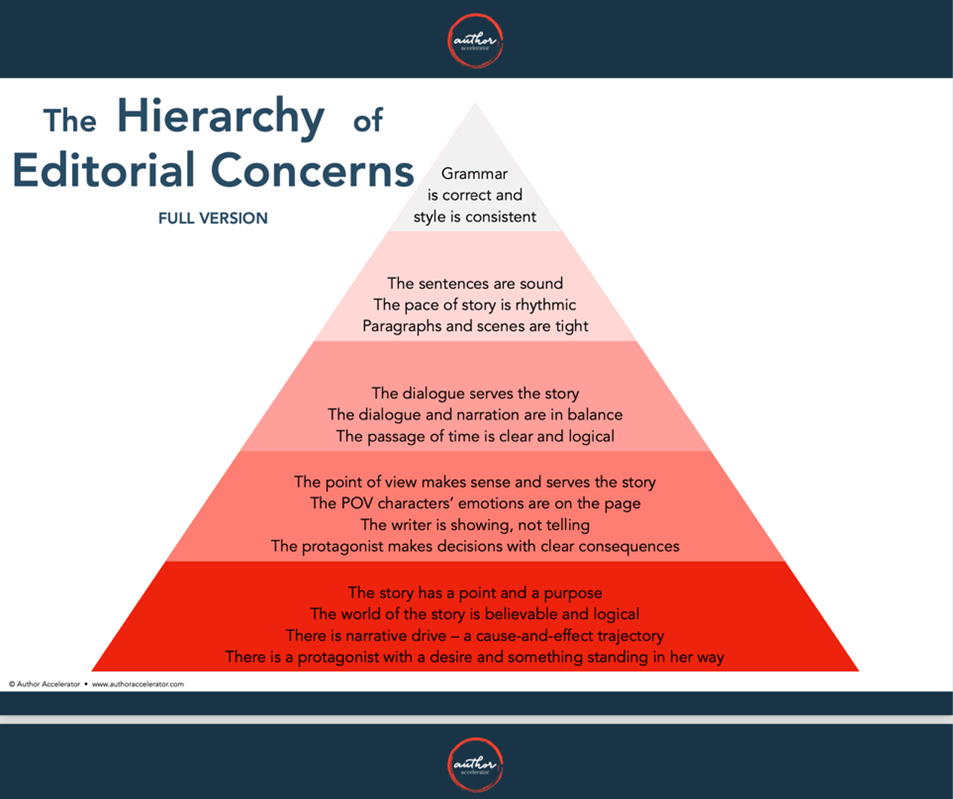
I always make sure I’ve addressed each of the points at at the foundational level before moving up a level with each round of revision. Depending on the manuscript, I may condense some of the levels higher up on the pyramid into a single pass, but none should be skipped completely.
Once all of your structural and story-level pieces are in place, then we can start talking about synonyms and similes and the proper use of a semicolon.
None of this is to say that there is one formula for revision that’s going to work for every author.
Your process is going to be a little different than every other writer’s because your work is different than every other writer’s.
But, having coached and commiserated with hundreds of writers, I want to protect you against wasted effort that leaves you stuck in the Writer’s Bermuda Triangle (trademark pending 😉), where you find yourself at the end of a lengthy revision with a draft that’s just as rough as where you started.
Our energy and enthusiasm for our stories and the time that we have to work on them are precious. Please protect your well of writerly creativity so it can carry you through to that final draft and onto your next shiny, new project.
Thanks Julie! I took your revision class a couple years ago and remember well the messy synopsis. I have a clean one now. There’s a voice that says I’m above the base of the triangle but of course I started at the beginning since everyone wants to see the first 10 pages! Thanks for this reminder!